
BY BRYCE PARKER
In New Zealand, the Mesozoic Era didn’t end until the 14th century. Before that, the island had not gotten the memo about the evolutionary paradigm that the rest of the world picked up 66 million years ago. Think of all the ecological niches traditionally filled by mammals like apex predators and browsing herbivores: in prehistoric New Zealand, these niches were all filled by birds. Giant eagles replaced lions and hyenas, moa replaced deer, and even the humble rodent was replaced by the nocturnal, burrowing kiwi. At the time, there were no terrestrial mammals in the whole chain of islands. Surprisingly, this wasn’t just because of the archipelago’s isolation but because what land mammals did originally inhabit New Zealand went extinct several million years prior (Worthy et al., 2024).
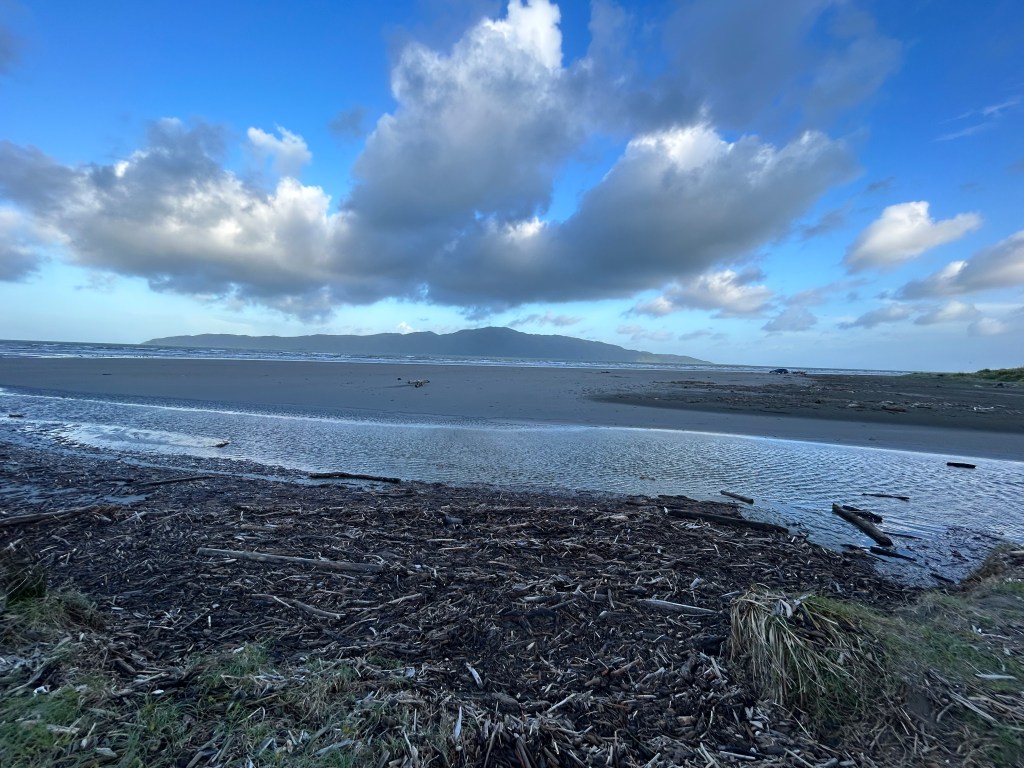
Offshore islands, like Kapiti Island (pictured in the distance) protect New Zealand’s rarest species from predation by invasives on the main islands.
The land was dominated by the descendants of dinosaurs, and many other aspects of the Mesozoic persisted throughout the landscape. Creatures such as the lizard-coded, but not a lizard, tuatara were once widespread in the Mesozoic, but now are found only in New Zealand. What really makes New Zealand’s biota unique is that, unlike other continents in the Southern Hemisphere, it was never connected by land to anywhere else. Strangely, it is likely that while New Zealand’s fauna gives the impression of a lost Mesozoic world, much of its current fauna reached the island in the last 20 million years (Goldberg et al., 2008, p. 3319). Its biota is likely more a restoration of the former glory of the Mesozoic than a direct continuation. Simply, New Zealand’s profound isolation made it a refuge for branches of the tree of life long since trimmed in the rest of the world.
Within the span of 500 years, the arrival of humans wrenched the island straight from its daydreams of the Mesozoic into the Anthropocene. New Zealand went from being an uninhabited, undiscovered land chock-full of giant birds and strange evolutionary relics to being a country with one of the highest human development indexes.
At the Te Papa museum in Wellington, one can walk this transition in a matter of a few minutes. This is a rather dour excursion, one best undertaken on a rainy day in Wellington. The museum itself is architecturally marvelous, but inside this exhibition hall lies a graveyard of biodiversity. Dozens of species were driven to extinction, first, when the Maori arrived, and then by European settlers.
These two events mark the two waves of the New Zealand extinction. The first wave marked the extinction of the megafauna of New Zealand, including the moa, adze bill, and giant eagles. The second wave of extinction mostly hit the numerous endemic songbirds and the fauna of offshore islands South and East of New Zealand. Researchers argue that in the last 500 years, 50 million years of evolutionary history were wiped out in the archipelago (Valente et al., 2019 p. 2563). Thankfully, the wave of extinctions has subsided due to hard-fought conservation efforts, and even species that once numbered less than 100 individuals are beginning to make a recovery.
Unfortunately, it is possible New Zealand will undergo a third wave of extinctions. As diseases like bird flu ravage the world, it appears that seabirds will be hit particularly hard and that in the next century, many species across the world will go extinct. Especially vulnerable to this threat are many seabird species endemic to the offshore islands of New Zealand. With small localized populations, sometimes with only a few breeding sites, these species could easily be wiped out by an outbreak of disease. Most of New Zealand’s remaining endemic avian fauna are sea and shorebirds, so this possibility means New Zealand’s already depleted ecosystems could become even emptier.
Interestingly, it is currently up for debate how many bird species are still extant in New Zealand. Throughout the 20th century, several species, once thought extinct, were rediscovered, and there are some who think this pattern will continue. One bird whose continued existence is unknown is the South Island Kokako, a grey songbird with orange wattles, which, as its name suggests, once lived on the South Island of New Zealand. This species went into a sharp decline in the middle of the 20th century, and generally was thought to have gone extinct in the 1970s at the latest. However, sightings have persisted in the rugged forests of the South Island. One of the sightings was accepted by The Ornithological Society of New Zealand and led to the bird being resurrected at least on paper.
On an emotional level, many want the South Island Kokako to still be hiding in the dense undergrowth of the South Island’s most remote groves, but realistically, it is long since extinct. Dozens of people have claimed to have seen a South Island Kokako since the year 2000 (Miller, 2025). However, the truth is, if they were all right about what they saw, the South Island Kokako would have been discovered some time ago. Some argue that the bird has taken on a more secretive nature since the arrival of humans (Milne & Stocker, 2014 p.137), but considering the tameness of most of New Zealand’s endemic avifauna, this is suspect. Today, with the proliferation of camera traps, environmental DNA, and the sheer number of people birding New Zealand, there simply isn’t anywhere for it to hide.
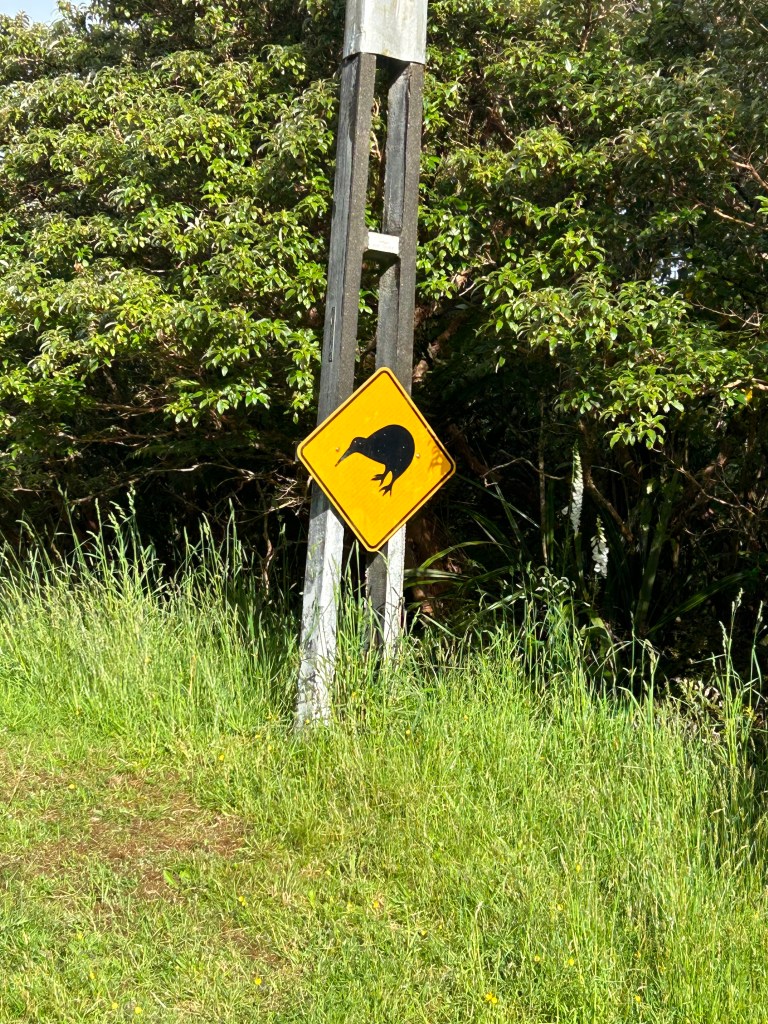
Kiwi crossing…
Despite its fame, the South Island Kokako is not even the most likely of New Zealand’s allegedly extinct birds to still be extant. A more likely candidate is Imber’s Petrel, an unassuming seabird once found on the remote Chatham Islands of New Zealand. Petrels and their relatives have a history of being rediscovered after hundreds of years of going undetected because they are difficult to spot and notoriously hard to identify. The New Zealand storm petrel was rediscovered after 150 years of presumed extinction in 2003 (Stephenson et al., 2008 p. 77). That species nested right off the coast of Auckland (Stephenson et al., 2008 p. 77), the most populated region of New Zealand, and managed to evade discovery for over a century, so a species from one of the more remote regions of New Zealand might remain hidden even today.
The differences between the New Zealand storm petrel and the South Island Kokako are stark. To the average observer, the New Zealand storm petrel would be a tiny black speck on the horizon. In contrast, the South Island Kokako is a distinctive bird that leaves little room for confusion as to its identity. Its relative, the North Island Kokako, is known to have a distinctive call, giving away its presence in even the densest forests. Songbirds are generally bad at hiding their location due to their proclivity for song. It’s in their name, after all.
Other better candidates for rediscovery include the New Zealand bittern and maybe the South Island snipe. Not that these are likely, or even plausible, just that the chances are ever so slightly above zero.
No one wants to admit that a species has gone extinct. This leads to outlandish claims of sightings for most of the extinct endemic species of New Zealand. People still purport to have seen moa, a bird taller than a human, in the forests of New Zealand’s Southern Island. There are sightings of many other birds, including laughing owls, huia, and piopio (Reddit, 2024). These sightings stem from the deep grief and guilt that flow forth from the anthropogenic destruction of our natural world. Guilt and grief feed a subconscious denial of the extinction of the species we could not save. These emotions cut especially deep when we share the collective blame for the disappearance of these species. Admitting these species are extinct means admitting we’ve done irreparable harm to the world.
References
Goldberg, J., Trewick, S. A., & Paterson, A. M. (2008). Evolution of New Zealand’s terrestrial fauna: a review of molecular evidence. Philosophical Transactions of the Royal Society B: Biological Sciences, 363(1508), 3319–3334. https://doi.org/10.1098/rstb.2008.0114
Miller, J. (2025). Possible Encounters with the South Island Kōkako. Sikct.maps.arcgis.com; South Island Kōkako Charitable Trust. Retrieved October 12, 2025, from https://sikct.maps.arcgis.com/apps/webappviewer/index.html?id=9e7a4c543b4b413d810700c8a465ba27
Milne, A., & Stocker, R. (2014). Evidence for the continued existence of the South Island kokako (Callaeas cinerea) drawn from reports collected between January 1990 and June 2012. 61(3), 137–137. https://doi.org/10.63172/854595qkhodr
Reddit – The heart of the internet. (2024). Reddit.com. https://www.reddit.com/r/NewZealandWildlife/comments/1gepbas/extinct_piopio_sighting/
Stephenson, B. M., Flood, R., Thomas, B., & Saville, S. (2008). Rediscovery of the New Zealand storm petrel (Pealeornis maoriana Mathews 1932): two sightings that revised our knowledge of storm petrels. 55(2), 77–77. https://doi.org/10.63172/044479vpejiw
Valente, L., Etienne, R. S., & Garcia-R., J. C. (2019). Deep Macroevolutionary Impact of Humans on New Zealand’s Unique Avifauna. Current Biology, 29(15), 2563-2569.e4. https://doi.org/10.1016/j.cub.2019.06.058
Worthy, T. H., Scofield, R. P., De, V. L., Salisbury, S. W., Schwarzhans, W., Hand, S. J., & Archer, M. (2024). A synopsis of the Early Miocene St Bathans Fauna from New Zealand. Geobios. https://doi.org/10.1016/j.geobios.2024.03.002
 Bryce Parker's Website